Friday, November 30, 2007

Where there's a will, there's a way

I used to think that line was a pretty trite comment, but I had cause to reflect on a couple of very different experiences of late that show the power of personal will, and the need to take personal risk to make change happen. It's really important if you want to create powerful customer experiences.

1. I went to our call centres the other day to listen to why customers are calling us (as opposed to contacting us in any other way - btw the reason they do is they want trusted advice from human beings. I'm sure there are other ways to do this that have the human touch but I digress). We had a customer call who wanted to cancel broadband - he wasn't using it. Craig (the rep) could have just gone through the motions and cancelled it but decided to drop his success rate on call metrics and take 10 seconds to look at the customer's overall bill. This guy was spending $350 a month - mainly on domestic and Australian calls. So Craig asks if he wants to look at other options and ends up selling a plan which will probably cut $150 a month off his bill. Customer is stoked and casually asks about mobile - Craig ends up selling him a phone sight unseen which will completely suit his needs. Customer is still paying less per month and now has a great mobile - all because Craig took the personal risk to engage in a conversation that the customer hadn't initiated.

2. I've been shopping around our user-centred design methods internally and talked to a number of senior General Managers. The value of what I was talking about was recognised immediately - however there was no will to implement. I can understand resources are tight, deadlines are near - we've all been there. A will to implement would find a way to get around that.

I had to reflect on the second experience - a normal uncontrolled reaction would be to say 'pack of muppets - they don't get it' but I've realised that I've got to have the will to back up what I believe in and find a way to make it stick. Which means persistence and probably an alternative approach. Thanks Craig from the Helpdesk in Hamilton - you've taught me a great lesson.

Friday, November 23, 2007

Science backs up beliefs

I've been involved in an ongoing conversation for years now.

I believe that if you treat customers well, put yourself out for them even, your business will be more successful. Customers will come back. You'll make more money. Everyone will be happy.

Problem with this is that is a belief based statement. Pretty hard to run analysis other than belief based churn reduction. Numbers guys don't like that kind of thing.

The good news for people like me is that Telecom's new CEO is very clear that putting customers first is very clearly our number 1 objective. Made life a whole lot easier.

Ironically - after a day listening to Paul Reynolds and being dead impressed by his commitment to this approach, I found this piece of research entitled Happy customers provide higher returns and are lower risk.Who would have thought, huh? Will be one for the back pocket when the accountants come around.

I blinked

It's been 7 months since I last posted here.

It would be easy for me to say that I had got too busy to post anything and this whole blogging thing is just a fad, so why bother.

But that isn't the truth. The truth is that I blinked. In the face of some feedback I literally stood still and didn't move. I won't share that feedback with you - maybe you'll notice a change, maybe you won't. It's also critical to note that it was feedback - not an instruction. And my reaction was to treat it as an instruction.

My purpose with this blog is to share my opinions and positions on things that matter to me, that I care about. Note the use of the word 'my'. It's not Telecom's position, it may not be my colleagues position - it's my position. And its for you to comment on and contribute to. I don't really mind if you flame me either - the point of this is to open up the debate on issues, provoke some discussion, and learn something that we didn't know before.

My view on this is simple - I am brave enough to share my opinion here. If you disagree with it, I'd ask you to be brave enough to tell me your counter opinion. Even better, do it as a comment here so we can do something positive with it.

Monday, April 16, 2007

Sprung on the 'net

So I've been 'found' on the 'net. Juha Saarinen - a regular contributor to the media landscape in NZ on all things telco and internet based has tracked down my very poorly updated blog and made some very pertinent comments about a couple of things in the piece.

1. Why does Telecom not have a Corporate Blog?

This is a funny one as last year Theresa got a few random people together to get their opinions on how we could get our people better engaged with the direction that we are taking. I was pretty adamant (in a 2006 kinda way) that a blog that was written by TG (ie NOT ghost written) would be a great way to go. It would take some investment and discipline but would be a great way for Theresa to get her message out. Her biggest issue was the supposed lack of authenticity of this medium. I have to say, based on a couple of comments I have received on this blog, that a direct way of commenting with her people (and I use that word in the broadest sense to include her staff, customers and broader stakeholders in NZ) would be a great way to gauge public sentiment and to explain why we do some of the stuff we do. Doesn't make it right or wrong but it most certainly means that you get your message out.

2. Juha thinks I should relax a bit

I must ask him about this as it could mean a couple of things

a. I am being too earnest in what i talk about (very possible)
b. I need to be more overt about my real opinion

This second bit is a little more problematic - and cuts to the core of this media - how do I express my opinion about something that pays for my family to eat (without being too dramatic). I guess the only way to do it, is to do it - so I'll be testing this boundary and seeing how my buddies react. A few of my posts have been too veiled which leads to the next point...

3. A commentor on Juha's blog, Michael, posts that I am a representative of another type of employee

The new generation of institutionalisation is the opposite - excited, passionate believers but so deep in their own corporate culture ("drinking the Kool-Aid") they can't see outside the walls or can't truly empathise with customers.
This had me more concerned that anything else as the thing I truly believe in is that for Telecom to survive (let alone succeed) that empathy with what customers really want is needed. I have an opinion that lots of people join Telecom for a whole lot of good reasons about how they can improve the lot of Telecom and its customers. But when they get in there, the path of least resistance kicks in and they find it easier to ensure customers don't leave us as opposed to make things so good that customers want to stay. You might think that is a subtle distinction but it's massive. And its time that it stopped. My response to Michael's comment is what I am doing to make that change stick.

Which leads me to the proposal on Friday for structural separation. There are lots of good reasons why you might want, as a shareholder, to keep Telecom in one piece. But there are a hell of lot more for splitting it off. Over and above the cost of making it happen (just think number portability x 10 - and its interesting to see that only one party has got that deployment right). One of the most important is that it would completely remove the temptation to try and 'game' the system. And I think that it would completely drive the right market behaviours like the following

A. The Network business would be solely responsible for building and maintaining bandwidth. Nothing more, nothing less. Its a big enough job that is fairly capital and resource intensive and if you got the right structure in place (ie must only ever be a wholesaler, never retailer ; ideally separate ownership) then you'd have some pretty good conditions that would work for the whole industry. And don't underestimate the issue about being able to make a reasonable rate of return - that would have to be directly linked to re-investment.

B. It would remove a huge constraint from the Retail side of the business. It's funny - you look around the 'net and see all the suggestions that people make for what Telecom could do and you realise being inside the business that if you didn't have to spend all your time lining people up to get commonsense stuff done that there are huge gains to be made in terms of innovation and Innovation (purposefully distinguishing between the 2). My own personal preference is for Retail units not much more than 100 people in size with truckloads of non-core services outsourced, running on a very lean internet based model with the same flexibility of our competitors. Would probably make some of them who used to work here a little uneasy if they knew we had the same nimbleness that they enjoy.

Looking forward to seeing how the market reacts but TUANZ's reaction was a very pleasant surprise. Some leadership here is great to see, especially when you wouldn't pick many bold moves with only 2 months and a bit to go until Theresa moves on...

Thursday, March 08, 2007

Claim this place

We've just opened up a new project office in Auckland for the work we are doing - I think this is an incredibly symbolic time for us. Here are some thoughts that I sent to Pawel to show what this means to me


This is a landmark time and place for us.

This is where we start to design the future. If we use the metaphor of the Kiwi Explorer this is our shed, our garage, our kitchen table. This is where we pore over our plans, covering off every uncertainty and trying to find the best way to make our quest happen.

If we were Edmund Hillary this maybe where he kept his bees, thinking about the mountains he might climb before he attempted Mount Everest. If we were Sir Peter Blake, this is the boat building yard where we tested ideas about new boat shapes, sail types and nutrition plans before we set off to San Diego to win the America’s Cup. Closer to home, if we were Kevin Biggar, this is where we would weigh every item we had and decide we really only need half a toothbrush while we were rowing across the Atlantic. Further away, this is the garage in Palo Alto where Steve Jobs and Steve Wozniak designed their first apple computer. This is our beginning.

This is a place about ideas and debate – where we are safe and free to challenge each other about whether what we are doing will really deliver on our dreams of running a lean business that will deliver product innovation in the eyes of our customers and a service experience that is unparalleled in the NZ business.

This is a place where we find out about what is inside us – for it is only by unleashing the capability that is inside us that will deliver on this dream.

It is a place where we will stand strong and united – for it is only as a team that we can achieve what we set out to achieve.

And it is a place about hard work – this is place where we do the preparation – the training, the theory, the mini expeditions to prepare us. This hard work is in the pursuit of an audacious dream that perhaps no-one thinks is possible other than us – and those are the best type aren’t they?

We will have our first reward in June when we will have completed our design for this new business. Until then I encourage you to ‘claim this place’ as ours. It is the place where we design our dreams – where we design a business that will be the future of Telecom, the future of its customers, and it will be a defining point in all of our careers. Our first challenge is to make this place tangibly different from what we have come from. I encourage you to do that – make it special. See it as our first test of doing things that are leaner, innovative and customer focussed.

Monday, February 26, 2007

Building a new business is hard work...

And that's not exactly a surprise is it. Thinking about where we are now in our project to build a new retail business vs. where I thought we could be by now, it's a hell of a lot harder than I thought.

So even if you are well funded (which we are) this building new business thing is not a walk in the park. In fact I think there would be some serious side benefits to not being well-funded - for one the fear that every EFTPOS transaction might be your last would certainly provide some more fundamental motivation to get stuff done faster.

Here's a top 5 list of why it's harder than you think.

1. You only know where you're going when you get there

Things change so much that you can only really ever have a general idea of where you might end up. Sure it's exciting - trying to keep people rolling with it is not that easier. How Columbus did it I have no idea.

2. You need to know everything

You might be able to delegate stuff to experts but really it all falls on you - especially if your business is about delivering roughly the same stuff in a different way, you HAVE to know if the different way is going to work. For someone who doesn't do a lot of detail, this means a lot of learning

3. No-one from the normal world gets it

People want to know why you're working insane hours, are always pre-occupied and telling them 'I'm coming up with a new business model that customers will love' will at best get you a quizzical eyebrow raise

4. Always challenging can turn into self-doubt

Building something new, you have to continually challenge what you're doing before you burn a lot of cash - people in your team who aren't used to this will turn this into self-doubt. Not a good thing.

5. Some days you're just surviving

I'll use an ocean-going analogy again. You get hit with 40 ft waves in your wooden ship sailing to the other side of the world you don't really care if you're still heading in the right direction - you just want to be alive. Sometimes you have do stuff for survival that won't take you in the right direction - not much you can do about it.

There's a heap of good things as well - they're well documented - it's how you get through the tough stuff that determines whether you'll be successful. Everytime I think about those pioneers who set out with literally nothing (Shackleton, Cook, Columbus, Erik the Red) combatting the best that Nature could throw at them, and generally heading in a direction where they didn't know exactly what they would find- sheesh, they did it tough. We've got it easy....

Monday, January 29, 2007

Great article on customer immersion

Excellent follow-on article from previous post about the need to talk to customers. This is the next step in our customer experience work. Thanks to Lynsey for the pointer

Resumption of service

And we're back for 2007 - been a long break between posts. And a chance to think about what I'll be doing for the coming year.

Only made one New Year's resolution - to start a revolution that will create a truly customer focussed business here at Telecom . Arlene thinks I am crazy but it's the one thing I really care about from a work perspective. I have lots of theories about why it isn't customer focussed currently- most are best left for a beer conversation as they tend to focus on what's wrong as opposed to how do you design a new future.

I've been working on this 'revolution' for a while now and thought that last year it had come to a grinding halt. We had an opportunity to pitch some of the work we have been doing around customer experience design to the Exec via a couple of GM's - in short I screwed up. Tried to make it too much about 'hey- this is cool. We're designing stuff. We never design stuff.' It came across as self-serving and I really thought I'd blown the chance for the team to get the right skills and resources on board to make sure we really design from the customer in. Spent a couple of weeks beating myself up about it as well.

The good news is that we had an opportunity for another part of the team to pitch this direct to the Exec and we reframed the story completely. Al and Dale took the exec through customer personas, showed how we use these to create options to meet customer needs and then tied this together in a way that hit what the Exec want to see - by designing from the customer in you can create a lean, low-cost organisation as you design out all the un-necessary contact customers have with you when things don't work. Exec love it, and we now have the resource we need to really design a world class experience. And to top it off, I've learned my lesson (again?) about the need to pitch it to the audience in a way that works for them.

revolution started.....

Monday, November 27, 2006

Why being there makes the difference

Couple of great little lessons in the last week about the power of being there in front of an audience, and telling them stories about how you see your business unfolding.

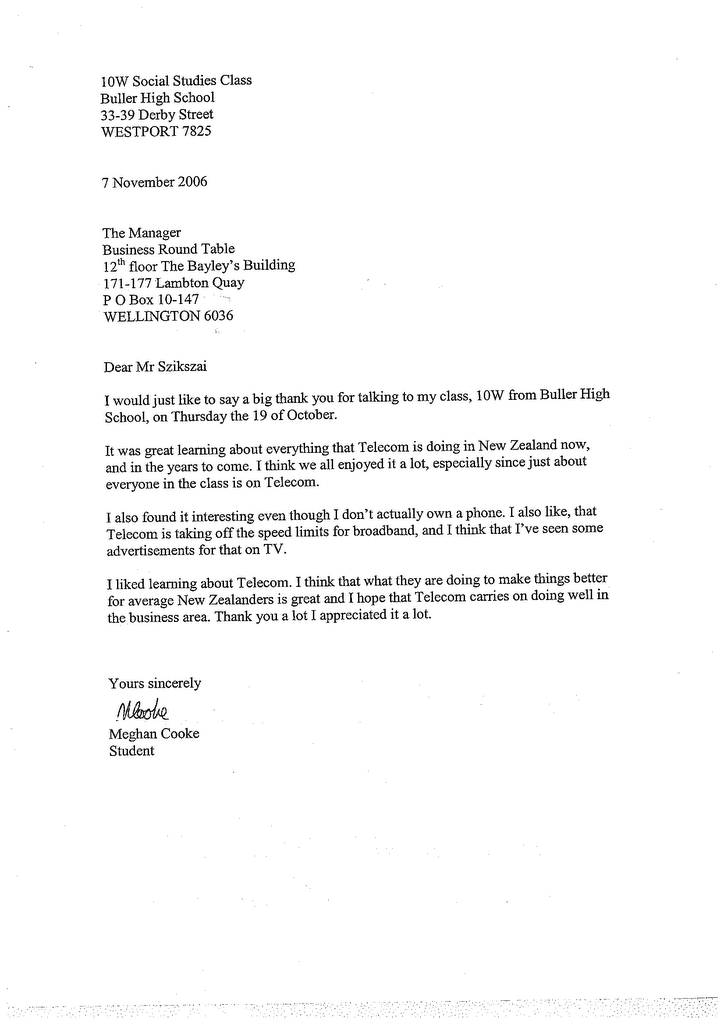
1. I got invited by the Business Roundtable to talk to a class of 15 year olds about a month ago about what I do at Telecom, what's important to us and the future opportunities that might exist.Given most of them have been alive just barely longer than I've been working here I told a story of how technology has changed so much in the last 12 years I've been here and how I've been able to do my little bit to make a difference. I got this letter from one of the students.

There are so many lessons in here, especially when you think of the context of this

  • Megan is not an existing customer - but I reckon there is every chance she might be one day
  • As part of this chat I got asked a very direct question of when we're going to roll out broadband to more rural areas and gave a very clear 'not for a very long time!' as an answer
  • I gave this talk to 45 people (30 kids and associated parents and teachers) - it probably cost me 3 hours of time (2 hours of prep and 1 hour of delivery) which, if I was being generous, probably cost Telecom $600. That is about $7 per person in terms of marketing cost and I reckon I got better cut through from this than any of our ads. This includes any in-direct benefit I would have got from these people talking to their friends and family.
I'm not saying we should ditch the TV commercials - clearly they work - but any chance to get in front of your customers in person (current ex- and future) has to be the best way to give your business personality and let your customers know you have a vision for THEM (not for you) and how you can 'make things better for average New Zealanders' - if it's not about that, then why are you here?

2. As one of my final acts in my old role, I gave a presentation on Thursday to the TUANZ business internet conference. It was all about how we research Emerging Technologies - which of course is actually all about understanding what are the problems that people will face in the future and how we can use technology to solve them. The guys put together a great demo of this based on streamlining the order and payment process for the local cafe based on the use of RFID. Worked really well and stimulated alot of discussion. Must say that the thing that really blew me away was Ernie Newman saying, in introducing the next speaker, that he was genuinely impressed that Telecom had a team of people who were so focussed on the customer and their problems, and that he held high hope for Telecom to execute its transition to a more holistic player in the NZ market - Paul Stoddart, Neil Forster, and all of the team at the old ETS (the new R&V) take a bow - you are actively changing the perception of Telecom for the better. One small team can make a big difference...

Monday, November 13, 2006

Usability Testing

Spent all of Friday doing usability testing on Residential Gateways.

Our technical team have shortlisted a number of models for us to look at as part of our Next Generation product set. Out of the 3 models that we looked at, and the 3 people we tested on, only one of them was able to get one model successfully working. Not a good look. There were a heap of issues. This includes

1. Having instructions printed in 10 point font that outline the need to run the CD before connecting any kit up.

2. Lots of device conflicts - we are going to have to get into some software development to resolve this

3. Some terrible language used in setting up the devices - the best example was a critical setting choice which had two options (World or Any)

4. The need for the customer to know ADSL log-in names and VCI/VPI settings

5. A device with no way to set it up other than to know the local IP address. Great.


So we learned heaps! For a start

1. We picked the right people to test on - non-techo people who got really frustrated when it wasn't simple. These are our target market. This is really important as I managed to get the device to work the night before but underestimated the pain that some people would go through. The video we have captured of the process is pure gold...

2. We have learned which information customers know off the top of their head vs having to have prepared

3. We have some really good insights into the look of the device - I don't think there is a way to make this device look acceptable in a home environment so we might as well just hide it.

4. We also have a great strawman for a proposed install process - to get to this in a day is a great result. This is the speed we need to work at...

Thursday, November 09, 2006

Movember

The last 2 out of 3 years I've been involved in a work fund-raiser to grow moustaches with the noble aim of raising money for Women's Refuge (all based on the loose premise that guys with mo's get a bad rep for violence towards women that's not justified).

This year I'm taking part in Movember - a fundraiser for men's health (focussed on Men's prostrate problems). It would be fair to say that a week in I'm feeling very rough around the edges and not having nearly as much fun as we did doing this as a more localised activity. I think the cause doesn't resonate with me that much (I mean - doesn't matter how much you advertise no fella is that excited about a protrate check) but I'm hanging in there.

Pic is a doctored view of how we're coming along - if you're up for a sponsorship, Please go to Movember , enter my Rego number which is 46881 and your credit card details. All donations over $5 are tax deductible.


Friday, November 03, 2006

Coming up for air...

The last month has been pretty crazy - we've been taking a good hard look at the strategy work required to deliver our new business and how we use products and services to do this. That's driven a whole lot of design activity that we are right in the middle of. There are some really good things that we've done and some things that we've learned that will be critical for making a new business come to life. Here they are in no particular order

1. The importance of the design process

OK - This seems like a really obvious comment. Everyone these days is talking about design - as a bit of an apple fanboy (sad but true) I've been going on about how we need to design things better for customers so that they work together. By taking a good two months to design what we want from both a customer perspective and a business perspective we are having the hard conversations now as opposed to starting down a path we might not be able to get out of later. This is helping us get senior engagement early and I am certain will mean that the actual build process is shorter and tighter - we won't be holding many options open at that stage for sure.


2. External skills and diversity are critical when you are looking at a transformation project

After 3 days into this process we had an 'aha' moment. While the 4 of us were all really focussed on executing our strategy and turning ourselves into something very different to what we are at the moment (think lean, fast and delivering services that customers love and contrast to what you think of Telecom today) there is no doubt that you gradually drift back to what you are comfortable with and what you know - this is exacerbated by the fact that we're all male, middle-aged (shock!) and well above the average age. Hardly our target market. We've brought in a number of people to help us through this - some internal (mainly female and with varying backgrounds) and a Design coach from Optimal Usability - Michael Andrews. He's been superb - not only is he a very experienced design professional, he's brough a level of customer focus to what we are doing that has meant that we just don't talk about things relative to how we operate today - really refreshing!

3. Turning yourself into a design-led, customer-focussed organisation is hard

As someone who has talked about being customer focussed and got frustrated about that, I have been surprised at the extent of the change I've had to make to be able to design products, services and a business from a customer perspective. Thinking about every decision in a customer oriented way takes a level of change that our current organisation is probably not able to achieve.I say this based on the following evidence

  • I'm open to customer oriented thinking - but doing this on a decision by decision basis means putting aside your entire decision making framework based on business outcomes, technology etc. That is a massive change - I suggest you try it to see how different it is!
  • We are only just learning the way to ask questions from a customer perspective - Michael has been awesome in getting us to frame up the initial questions of how a customer would want to experience the service in language they would understand. This a new skill for us.
  • While we touch customers every day our actual interaction with them and experience of how they understand our products and services is really limited - we don't feel their pain enough. Tomorrow we're going to get some people to do some usability testing on existing products so we can see where we are starting from - I expect to take some grief...

4. Our new business model is the problem to solve - not the product set

We started off looking at this from the perspective of designing new products and services and the processes that sit around them. Seemed reasonably straight forward - the fact is the change is so big that you have to design what your new business looks like from top to bottom so you know what you're delivering to. This has been controversial - we're getting a lot of push-back on this along the lines of 'trust us - we have this under control'. The fact is - if we are finding it hard to turn ourselves into more customer oriented people and design that way in, how can we possibly trust people to design a business model who don't have that world view. Still employed this week so hoping that some of what we are saying is resonating...

5. This is not delegatable

Well - I certainly couldn't delegate it and I won't be. It's pretty easy to delegate stuff you know that's incremental or relatively low risk. This is complex, requires new skills to be learned and we're banking the business on it. Seems like something too big to be delegated 3 levels down but what do I know.

Huge month - and i reckon the next 2 will be even bigger - must do some daily updates for a change.

Monday, September 25, 2006

New Job

It's been a while between posts - since then I've decided to take on a new role within Telecom heading up its Next Generation Product Management group. This role is part of the Consumer Business Unit and is primarily focussed on developing the product set that will be at the core of our next few decades. It will mean moving the entire residential set of products (and some wireless) onto new product platforms that are all IP based. This will transform the product set, and if done well, transform our business.

A few people have asked why I have decided to take on this role, which will be challenging (in the least!), as opposed to keeping on going with the role that I've had in researching customer behaviour and new technology.

For me, it's come down to a few things

1. Delivery - I really enjoy picking trends, but I found it very frustrating seeing these ideas incubate without getting to market. This role provides the opportunity to still use those skills and also combine them with getting stuff to market.

2. The Everest effect - this is a huge challenge - delivering a product set that is so compelling that all our existing customers choose to take it over all other alternatives by 2010. And the future of the business rests of achieving this successfully. I love the scale of this challenge and the possibilities that it creates!

3. My career - self-centred I know.... But I need to lead something of this nature to take my career to the next stage. This will make or break me. Everyone needs a little adrenaline in their life - this is mine!

It took me a good week of soul-searching and talking with key people inside and outside Telecom for me to feel confident enough that enough of the environment is in place for this to have a chance of success. Not all the pieces are there though - in particular a really clear view of what needs to be done by when, and described in such a way as to make everyone excited and motivated about getting in behind this. But I guess I have to do some of the hard work, don't I?

So the tone of this blog (when I write it of course!) will change and be more about the how we start building a team, some vision and then start executing. Next posts will be about describing the problem a more and how we're going about building a team.

Monday, September 04, 2006

Get your head around Identity 2.0

Tom Glover has been doing a LOT of work on identity - including building some core identity infrastructure (purely for prototypes of course!) as we speak. On top of that Tom is presenting at the invitation of the Office of the Privacy Commissioner on a "Day in the (digital) life" on 21st September in Wellington. Post a comment and I'll get you the details to get along - it's private up until then :)

I have to admit that while I get the need and opportunity for Telecom in the Identity space, I've never been able to articulate it clearly. I found the following links which have pointed me in the right direction.

Firstly a 15 minute primer on identity by Dick Hardt (anyone who has a tagline "who's the dick on my site" is worth a look). Not only does it get you up to speed with identity, its a great presentation from a style perspective. It was found on a list of Top 10 presentations in a review by Guy Kawasaki.

Secondly - add this site to your RSS feed reader.


Between these two links there is all you need to know about Identity 2.0

So the next thought has to be - where could Telecom be in all of this ? The answer most certainly isn't 'in the middle of it'. That's the customer's place. But we have a role to play - we just have to make sure that we aim to participate as opposed to control. Otherwise we will end up like Microsoft's Passport - REJECTED!

Monday, August 28, 2006

A fine pickle we're in...

I've tried to stay away from political leanings but feel compelled to write a few words on this (I'll categorise it under 'Thoughts on Fatherhood' as it's critical to the world that Ella will live in if we are in NZ).

I had a very insightful experience a couple of weeks ago. i was invited to a 2 day symposium run by the NZ Business Roundtable on the importance of public policy to the future of NZ. The event was targetted at so-called Emerging Leaders. It killed a few myths for me and certainly got me thinking a bit.

Firstly the myths

1. I always thought the NZBR was a lobby group that is primarily aimed at lining the pockets of big business ( a few socialist traits coming through there..) - it's not. It's a think tank that focusses on the research and development of public policy with a particular focus on human flourishing. It's almost noble.

2. Relatively, we've come through the last few years unscathed - fact is we've been lucky and we haven't been investing for the future of NZ in key infrastructure (roads, hospitals - the important stuff). We're in trouble and we're falling further behind

3. MMP is a great leveller for governments and stops them getting out of control - it's the opposite : MMP drives GROWTH of government. More specifically in NZ, the core civil service has increased in by the same amount in the last 5 years as the previous 160 years. I knew we were getting bloated but that just stunned me.

This session also stimulated lots of thoughts - here are a few

1. We have to find a way to limit government. Peter Boetke put it best at this event. We are caught between the erring entrepreneur and the bumbling bureaucrat. The erring entrepreneur is at least likely to get weeded out by market realities. The bumbling bureaucrats hang around for ever until an electoral discontinuity occurs (eg Lange / Douglas in the 80's) and actively avoid reality.

2. Despite the notion of public policy being important, particularly businesses needing to take a long term view, there was only one group of people who were actively planning for a long term future - Maori. I have taken this view based on a presentation given by Tahu Potiki who is CEO of the Ngai Tahu trust. He was talking about how Ngai Tahu are planning to get returns on their settlement with the Crown that are focussed on sustainably improving the level of education of Ngai Tahu people. In order to do this they are taking a 30 year view - who does that in business? It means they will, in Tahu's words, skip a generation of benefits. That's a big call - but clearly the pay-off is there. Incidentally the panel with Tahu, MP Shane Jones and Rob McLeod convinced me that Maori Leadership could possibly be the key to NZ's future. They are dynamic, bright and very astute. Moreover their Maori background makes them grounded and more holistic in their approach.

3. Making a stand for less government is the equivalent of political suicide - how do you convince the majority of the nation (who are in someway the beneficiaries of the government's largesse )that it is not in their best interests to get handouts and that we would all be better off with a simpler tax and incentive structure.

4. Governments are bad at designing incentives
A great story was told by Alan Gibbs about how he successfully ran a business that manufactured TV's in NZ. The rules at the time said he could not import them fully built up. He went to a Japanese manufacturer who had to de-construct already assembled TV's, send them to NZ where they would be re-assembled. Gibbs recieved an incentive for this new industry - consumers paid twice the global average price for TVs and a nonsense industry was created that would fail once the incentives were removed.

5. We have an amazing bunch of successful business people in NZ who are willing to share their experience and time with people like me - any chance you get to talk with people like Alan Gibbs, Ron Trotter, Gil Simpson amongst others is a real treat.

Wednesday, August 16, 2006

Wiki's rock

We're just about to launch our internal wiki. Atlassian has introduced an Enterprise blog piece of software. Looks pretty cool and maybe a next step. Rod Drury points to an analysis that is right on the mark. There is a heap of power to be harnessed in tying wiki type technology alongside enterprise data - looking forward to this making a real difference in the speed at which we develop new concepts and ideas.

Tuesday, August 15, 2006

The world of duct tape

Gabor pointed me to this today - a site exclusively devoted to cool things you can do with duct tape. I personally liked the duct tape wallet.

It's so nerdy that its almost (note the use of the world almost) cool. Goes to show you a couple of things

1. You can do the same things with different materials and styles and get great results
2. Opening your eyes and being resourceful is a pretty rewarding experience - I like the way this guy publishes the instructions for free and its now being used by Youth programmes

Just don't make the Marvin the Martian outfit please...

Sunday, August 13, 2006

On my way to Internet millions!!!

or maybe not...

For those of you who noticed, there are google ads located on my blog. I did this merely out of interest to see how this model works.

It's quite fascinating to note that since I've put them on the pages, not one ad has been clicked. But as a result of page views, I've still generated some income. To be specific I've tripled last month's income of 1 cent (USD - mind you) to 3 cents USD. On a geometric basis that means at current course and speed I'll hit 7$ USD by January 2007 and $1.3 million by December 2007!

Of course on an arithmetic basis it probably means I'll have to stick to the day job...

The Perfect Age

I watched this show tonight 'The Perfect Age' . Admittedly it was out of self interest as I had been asked to appear as a guest 'technology expert' on the show.

It was pretty clear as I was watching that I wouldn't be appearing (first rule of telly - if you're not on before the first ad break, its happening without you) and I have to admit that when I saw that Peter Sheahan guy I was thinking 'WTF - they've replaced me with some made-up Australian with a hair product fetish!!!'. Due to the wonders of wireless communications I was able to see that the guy is real and he blogs at the same time as watching the show (my rant lasted about 30 seconds dammit). So I've come to terms with the fact that he is better TV talent than me, as we were pretty much saying the same thing with regards to the differences between younger and older people (Gen Y, Gen X and Baby Boomers in this show) - younger people have been surrounded by technology longer and are much more agile when it comes to dealing with new problems and challenges that are technology related. My previous blog on Digital Natives was getting at the same point. And I have to say that he was much more succint in the way that he was making his point.

The other really interesting part about this show is how the Baby Boomers dealt with learning and memory. They were really really slow in picking up new ideas whether they were technology related or following driving directions. But when they got it, it stuck really hard - to the point they were able to drive a random map course in reverse five days after the fact!

I am using this to inform a piece of work we are doing on some technology for older people that allows for greater independence when older - can't wait to test it with some real Boomers!

Friday, August 04, 2006

No such thing as MY job

For those who hadn't noticed, Telecom is going through the biggest change to its structure and design in at least the 12 years I have been lucky enough to be here.

At this stage, almost all of Layer 4 (Direct report to GM) has been redesigned. It should result in an organisation that is more agile and better able to deliver to customers in a world where IT, telecommunications and media are colliding.

This of course is not without its share of stress - when your current role has changed and you have to apply for a new one (or what you think is your curernt role) then a bit of stress is understandable. However it does need some perspective...

The most common thing I have heard is over this time is 'They can't do this to me / you - that's my / your job!!!' I have news for anyone who thinks that way - the job you have is NOT your job. You don't own it - the best you can do is to see yourself as a steward in that role - to leave it in better shape than you found it for the next person. And a really important part of stewardship is to realise that the time you have to perform that role is set by someone else - you don't always get decide when you're done.

I've had a lot of people say to me 'I've heard so and so is interested in your job' - well I'm all for that. In fact I encourage it - if we are going to grow up as an organisation then we have to very quickly get used to a world where roles change much faster than they have in the past. That starts with working out what is best for the customer as opposed to your job description.